Tuesday, 22 October 2013

Explaining the Base 10 System: One Hundred Thousand Squares Later!

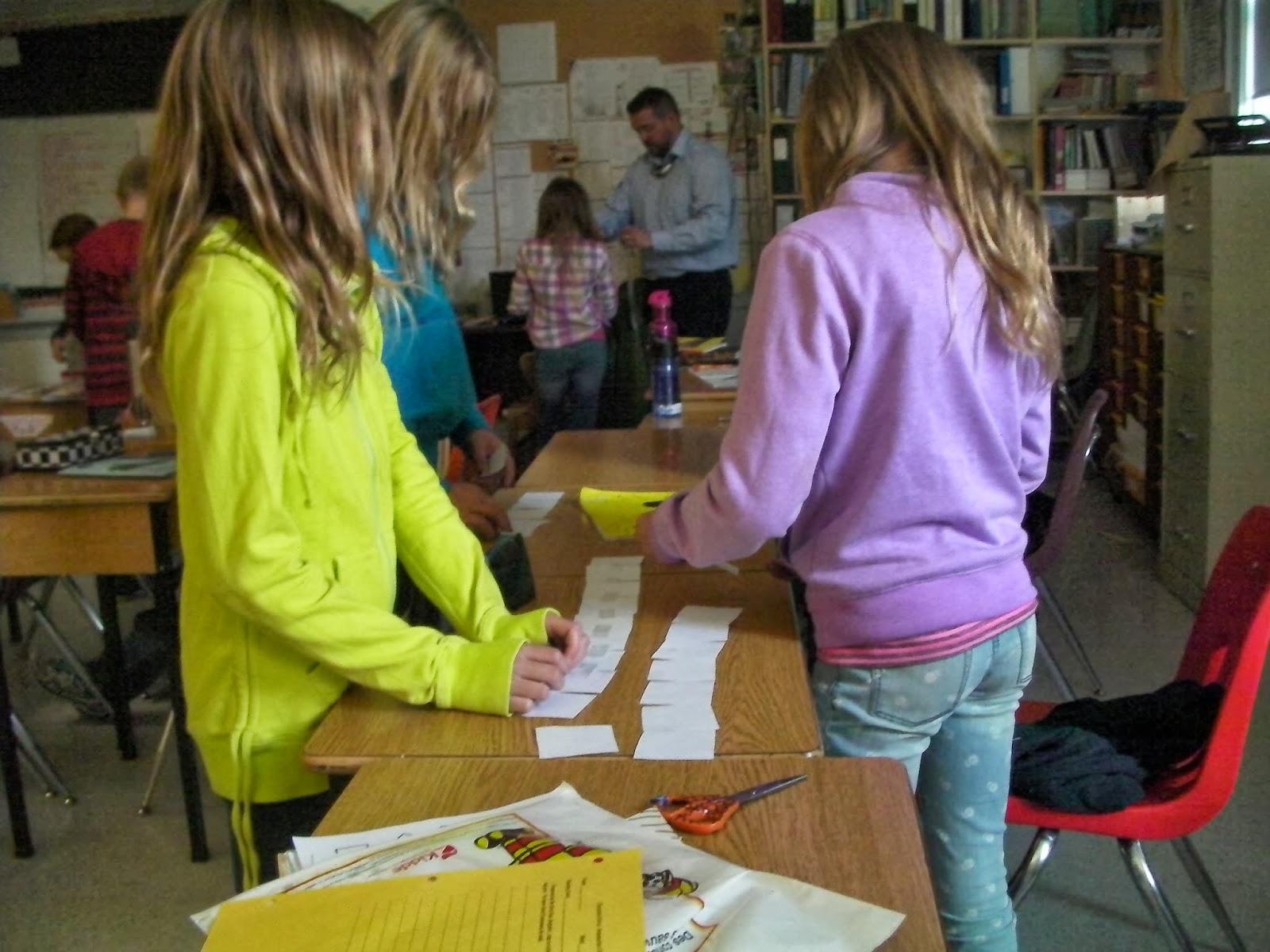
Since school has started, our class has been working with the base 10 system.  Trying to understand the base 10 system can be hard to conceptualize, so the class has worked at creating more concrete examples.  In the video below, our class has  shown the relationship between 1s, 10s, 100s, 1 000s, 10 000s, and 100 000s using small squares.  Students quickly realize that when number increase in size, 10 times the size can be quite dramatic!  In end, it is hoped that students will get a better appreciation for the size of 1 million!

                                         Thanks to Logan for the video!


                                         In the end, students realized that if they wanted to show
                                         1 million squares, they would have to make this long line
                                         ten times as big!  (Approximately 11 hallways long!)

                                         Thanks to James for taking the pictures!


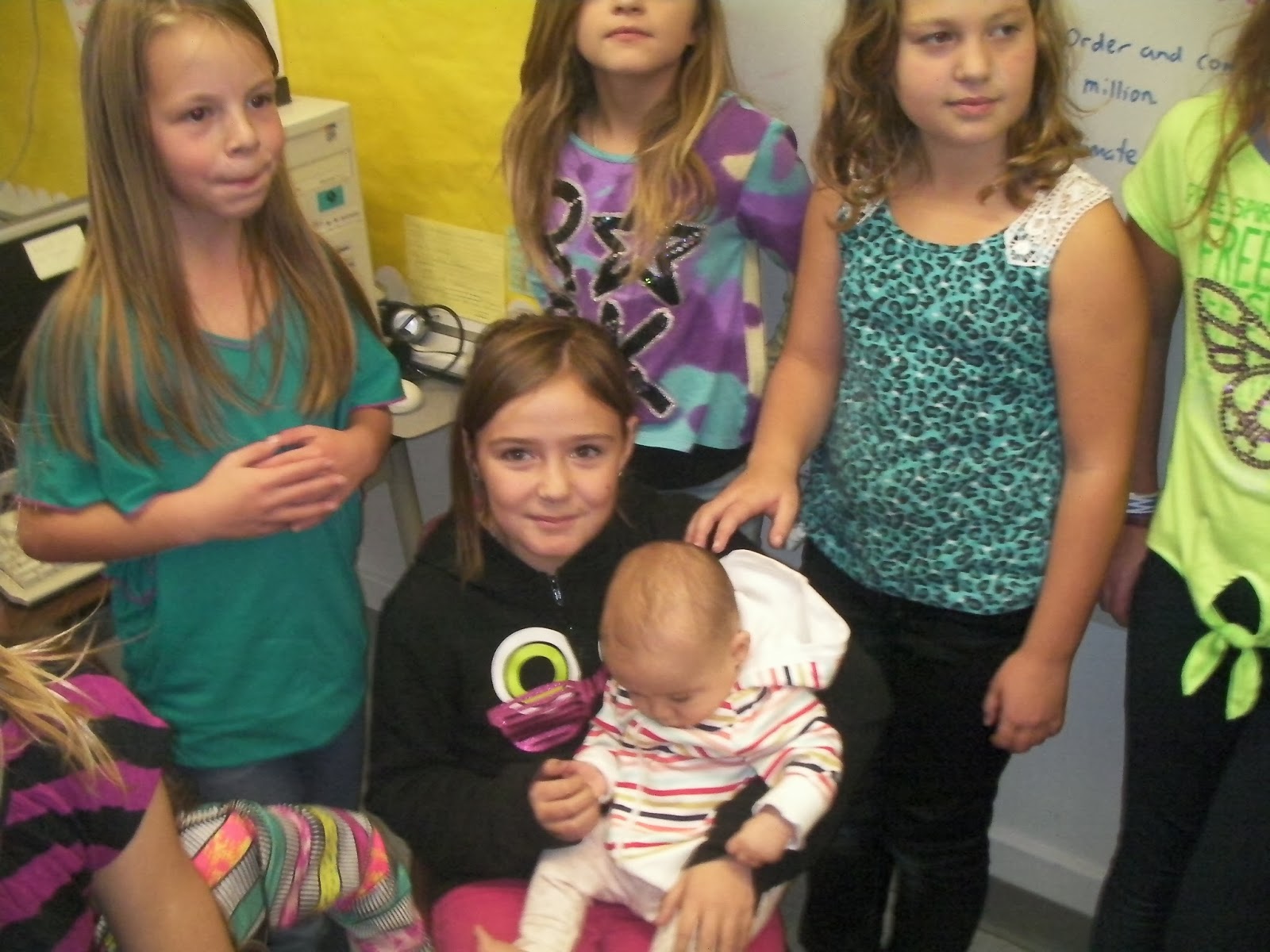
                                         Mrs. Takeda stopped by our class to say hello!


Secret Code for Agenda:  Baby Mia

Sunday, 20 October 2013

Social Studies Mapping Test -- Monday November 4th

Our unit on Mapping Major Physical Areas of Canada is coming to a close.  Over the next two weeks, students will be working on their mapping assignment.  In addition a Mapping Test will be given on Monday November 4.  For the next two weeks, the only spelling words that will be assigned have to do with the upcoming test.  While time will be given in class, many students will require additional practice at home.


Study Guide:   Social Studies Test on Mapping
Test:  Monday November 4th

Each student has completed a Student Booklet to Assist with Studying.  Half a mark will be deducted from each word spelled incorrectly.

1. Students will need to be able to label the continents and oceans of the world with correct spelling. 

·         Continents:  North America, South America, Europe, Asia, Australia, Antarctica,
                                 and Africa.
 
·         Oceans:  Pacific, Atlantic, Indian and Arctic.

2.  Landforms:  Students need to match the definition to the word.  Also, students will be asked to label each landform on a map.
·                                             Define –
o   Island:  land completely surrounded by water.
o   Peninsula:  a long, narrow part of land almost all surrounded by water.
o   Hill:  a raised part of land, not as high as a mountain.
o   Valley:  a long, low-lying area between higher land, often with a river flowing through it.
o   Mountain:  a large, steeply raised part of land, much higher than the land around it.
o   Lowland:  a low-lying, level part of land.

3.  Water Bodies: 
·                                              Define: 
o   River:  a large, natural stream of fresh water flowing downward in a channel.
o   Lake:  a body of water, smaller than a sea and surrounded by water.
o   Sea:  a large body of salt water.
o   Ocean:  a very large body of salt water.
o   Bay:  a large, wide, deeply curved inlet along a coastline.
o   Gulf:  part of an ocean or sea that is like a wide, large bay.
o   Strait:  a narrow passage of water joining two large bodies of water.

4.  Mountains:
·         Students will need to label the following terms on a diagram:
o   Peak
o   Ridge
o   Slope
o   Snowline
o   valley

5.  7 Physical Regions of Canada:  Using the map, students will be asked to match the correct Physical Region to the map. 
      a)  Canadian Shield
·         b)  Arctic Lowlands
·         c)  Great Lakes-St. Lawrence Lowlands
·         d)  Appalachian Mountain 
     e)  Western Mountains or Cordillera
·         f)  High Arctic

6.  Labeling Major Landforms on a Map of Canada: 
       Baffin Island
·         Ellesmere Island
·         Hudson Bay
·         Gulf of St. Lawrence
·         St. Lawrence River
·         Labrador Sea
·         Beaufort Sea
·         Mackenzie Mountains
·         Rocky Mountains
·         Coast Mountains
·         Vancouver Island
·         Five Great Lakes:  Superior, Ontario, Erie, Huron, and Michigan
·         Lake Winnipeg
·         Great Slave Lake
·         Great Bear Lake
·         Hudson Bay Lowlands
·         St. Lawrence Lowlands
·         Laurentian Hills

Wednesday, 16 October 2013

Life in Grade 5!

Math:  We recently had a test dealing with place value to 1 million.  As part of our learning, we have been taking time to find different ways to represent  1 million.  One way involves cutting out squares that will represent 1, 10, 100, 1 000, 10 000, and 100 000.  Due to the shear size, we will have to get creative if we decide to show 1 million.  Keep posted to see the results.


Cutting out 1 million dollars in one hundred dollars bills is taking some time.  That said, we'll get there eventually!


The Grade 7 classes recently went Potato picking to help collect food for our local food bank.  With the left over potatoes, the Grade 7 classes baked us potatoes, complete with butter, sour cream and green onions!


Beyond Recycling started today.  The theme for today was the evolution of Garbage.  Students quickly learned that since the beginning of time, humans have only increased the volume of garbage we have created.  Students will be challenged over the next five months to look at their own lives and see what ways they can help reuse, reduce and recycle!


                                         Cave Man times with Logan.

                                        The Introduction of Farming with Tyson.

                                          Life in Greek Times.

                                          The Industrial Revolution with Heath.

                                         Post World War II Era with Keiryn.

                                          Present Day with Madison.  However, she needed the
                                          help of Keiryn to show all the waste we produce!

Writing Assignment: School on Saturdays?

Over the past week, our class has been working on the four types of sentences.  These included Declarative, Imperative, Exclamatory and Interrogative sentences.  Students are expected to use these four types of sentences in their upcoming assignment.

Assignment:

The Board of Education for School District No. 8 is looking at ways at increasing the Academic success of students within their district.  From this discussion, a motion has been put forth to increase the school week from five days a week to six days a week.  The end result would see students attend school on Saturday morning from 8:00am to 12:00pm.  Since the board is aware that many students may struggle with this idea, they are allowing students to write a paragraph addressing their concerns.

Criteria:
  • Paragraph must be at least five sentences.  1 Mark for five to six sentences.  2 marks for seven or more sentences.
  • Students must use all four types of sentences in their paragraphs correctly.  4 marks.
  • Must include the correct ending punctuation for their sentence.  4 marks.
  • Must be typed on the computer.  2 marks.
  • Must use a topic and clincher sentence. 2 marks.
  • Use correct spelling.  2 marks
  • Use capital letters appropriately.  2 marks.
  • Include a title, name and date.  2 marks.
Total Marks:  20 marks

Students must use a USB Flash drive so they can save their work. 

The assignment will be started Thursday October 17 and must be completed by Wednesday October 23.  Plenty of class time and computer time will be given.  That said, students are encouraged to use their memory sticks at home if necessary.


Sunday, 6 October 2013

Summit Creek Part 2

More photos and one more video clip!  Had three more video clips to upload, but it will not allow it.

                                          These boys are not afraid of getting dirty!

Scott and Kimberly


                                          The "Web of Life" Analogy.

                                         Maybe we should have eaten lunch sooner!

Summit Creek Part 1

Luckily it was a terrific day to be outside!  The students had a great time learning from the forest!  Please enjoy the pictures and short video clips!
 Each student was given a job to do on our tour!

                                         Scott and Andreas

Spencer and Rocco

Kate and Jada

The group was learning about the "pull" in a forest and 
the importance of keeping a balance.

Start of the day.


                                          Cheyanne and Jet.

                                          Amber and Anika.

                                          James and Logan

                                          Kelsey and Kimberly

                                          Madison and Kate

Monday, 30 September 2013

Spelling Program

Dear Parents/Guardians,

Sorry for the long winded response.

The spelling program that will be used this year in class focusses on the most commonly written words in the English language.  In total, there are 1 200 words in the program ranging from Grade 1 through to Grade 7.  Of these words, the 1 200 words that students are working towards make up 91% of all words written in the English.  Therefore, all the words that students will be working on are common everyday words.

Since students are at many different levels, students will be working each week on words specific to them. Each student has their own list of words to practice.  Every Monday, students will pick ten words to practice.   On Friday, students will be tested.  Students can only move onto new words once they have mastered the words they are practicing.  Any word that is spelled incorrectly will be added to next weeks list.  As students are working at their own level, I will be working hard to teach students how to test each other.  With 27 students, it is impossible to have 27 individual tests.  While it may be slow to start, I am confident that the students can handle this responsibility.

Students will be bringing home a master list of the words covered so far.  Please have a look at the list so you can see which words they need to practice.  While the majority students have been tested to the first 500 words, there are a few students who need further testing.  These students will keep testing until they have enough words to practice over the year. 

When looking at the list, please ensure they have spelled the word correctly.  I have explained to students that it can be difficult to practice these words as they have incorrectly memorized these words into their long term memory.  Essentially, they need to be vigilant and retrain their brain.

When practicing the words at home, please have your child has :
  1. See the word
  2. Say the word
  3. Cover the word
  4. Write the word
In addition, students have to be aware of homophones (words that sound the same but are spelled differently).  Many students may have words they can spell, but are unsure when to use it.  Some common examples:  (their, there, they're), (to, too), (it's, its)

Note:  The level of difficulty for each word depends on how common the word is used.  Therefore, the higher the word on the list does not necessarily make the word more difficult.

If you have any questions or concerns, please contact me (agenda, phone: 250-428-2051, email: mblick@sd8.bc.ca).